Wednesday, December 30, 2015

Economic Benefits of Trails, Parks, and Open Space in the Mat-Su Borough

Abstract
Community assets such as trails, parks and public open space provide numerous  benefits of both economic and social value. These assets provide recreational  opportunities for residents, helping people to stay healthy and happy as access  to spaces for exercise increases physical activity and reduces medical expenses.  Recreation also stimulates the economy through the purchase of gear for activities,  services and guided tours. This economic activity creates jobs in recreational sales,  the hotel industry, tourism, and more. Public spaces enable all of these benefits  to happen. Without access to trails, parks and open space, these benefits would  be greatly diminished. This report summarizes the return on investment for these  community assets in the Matanuska-Susitna (Mat-Su) Basin of south-central Alaska.  Both social and economic benefits are covered in this report. Social benefits  encompass recreation, tourism, human health, public safety, subsistence, and  cultural and historical benefits. Economic benefits include those from businesses,  tax revenues, and taxpayer savings.
...
[The study finds]:
  • Opportunities for physical activity in open spaces can decrease both health care  costs and   productivity losses, leading to more than $3 million in savings annually.
  • The high cost of natural disaster recoveries, not to mention the loss of human life,  can be  minimized with well-planned open space preservation.
  • The estimated annual value of ecosystem services of the 1,438 acres of Mat-Su  Borough owned recreational land is over $1.8 million.
While the figures above paint a positive image of Mat-Su public open spaces, the ROI  analysis was crucial to determine the actual costs and benefits of spending money to  enhance and preserve open space in the Mat-Su. As Chapter 5 details, we reached  a result of a 5.31 return on investment for the Mat-Su Borough owned lands alone, meaning that for every dollar that the Borough invests in open spaces, the payoff is more than $5, an astoundingly good return.
by Maya Kocian
Earth Economics www.EarthEconomics.org
December 11, 2015
The Full report is available free of charge at http://tinyurl.com/zrxowfh

LEED Certification of Campus Buildings: A Cost-Benefit Approach

Abstract:
This is the first comprehensive cost-benefit analysis of Leadership in Energy and Environmental Design (LEED) buildings certified within the higher education sector. Sixteen institutions of higher education (IHEs) were surveyed with the findings focused on the upfront green premium and down the line energy savings. The net present value (NPV), internal rate of return (IRR), and discounted payback period were calculated to determine the financial feasibility of LEED certified buildings within the higher education sector. The findings indicate mixed results when looking at the projects from both an upfront construction cost and full lifecycle perspective.
...
The relationship between LEED level and energy savings per square foot per year was reviewed after removing the outlier of $42.37/sf. As Exhibit 3 illustrates, there is no relationship between LEED  level and energy savings per square foot per year. The lowest annual energy savings $/sf were LEED level platinum buildings and the highest annual energy savings $/sf was a LEED level gold building.

LEED Gold Searle Chemistry Lab at the University of Chicago with green roof
In order to address the second research question of lifecycle energy benefits versus the upfront costs of LEED-certified campus buildings, a net cost-benefit analysis was performed. Calculating project performance criteria was done using NPV, IRR, and the discounted payback period for each survey with a discount rate of 3.5% and a building lifecycle of 25 years. The NPV, IRR. and discounted payback period for each of the 16 surveys are shown in Exhibit 4. NPVs ranged from $232.20 to  $698.32. IRRs ranged from 20.18% to 51.02%. The discounted payback period ranged from 0 years to 10.48 years. There were 10 surveys where the discounted payback period was not calculated as it exceeded the building lifecycle cutoff of 25 years.
...
Previous studies have failed to focus on the higher education sector as it relates to LEED-certified buildings. Therefore, there was limited literature and data on the subject. However, when reviewing the literature, the results showed an upfront green premium of $0–$9/sf. For the annual energy  savings, results ranged from $0.10 to $2/sf. The results for the green premium ranged from $0.00/sf to $235.00/sf. When the outlier is removed, the green premium ranged from $0.00/sf to $12.00/sf. 

The annual energy savings ranged from $0.17/sf to $42.37/sf. When the outlier was removed, the annual energy savings ranged from $0.17/sf to $0.75/sf. When comparing the existing results to the  current results without the outliers, they seem to be somewhat in line.

There were two extremely high outliers in this study. Firstly, there was a green premium reported of $235/sf. The respondent may have answered in a different measurement versus dollar per square foot. That is why the median was used in this case. Secondly, there was an annual energy savings of  $42.37/sf reported.

Wind and solar boost cost-competitiveness versus fossil fuels

This year has brought a significant shift in the generating cost comparison between renewable energy and fossil fuels, according to detailed analysis by technology and region, published this week by Bloomberg New Energy Finance.

The research company’s Levelised Cost of Electricity Update for the second half of 2015, based on thousands of data points related to individual deals and projects around the world, shows that onshore wind and crystalline silicon photovoltaics – the two most widespread renewable technologies – have both reduced costs this year, while costs have gone up for gas-fired and coal-fired generation.

The BNEF study shows that the global average levelised cost of electricity, or LCOE, for onshore wind nudged downwards from $85 per megawatt-hour in the first half of the year, to $83 in H2, while that for crystalline silicon PV solar fell from $129 to $122.

In the same period, the LCOE for coal-fired generation increased from $66 per MWh to $75 in the Americas, from $68 to $73 in Asia-Pacific, and from $82 to $105 in Europe. The LCOE for combined-cycle gas turbine generation rose from $76 to $82 in the Americas, from $85 to $93 in Asia-Pacific and from $103 to $118 in EMEA.


US energy LCOE


Seb Henbest, head of Europe, Middle East and Africa at Bloomberg New Energy Finance, commented: “Our report shows wind and solar power continuing to get cheaper in 2015, helped by cheaper technology but also by lower finance costs. Meanwhile, coal and gas have got more expensive on the back of lower utilisation rates, and in Europe, higher carbon price assumptions following passage of the Market Stability Reserve reform.”

Levelised costs take into account not just the cost of generating a marginal MWh of electricity, but also the upfront capital and development expense, the cost of equity and debt finance, and operating and maintenance fees.

Among other low-carbon energy technologies, offshore wind reduced its global average LCOE from $176 per MWh, to $174, but still remains significantly more expensive than wind, solar PV, coal or gas, while biomass incineration saw its levelised cost stay steady at $134 per MWh. Nuclear, like coal and gas, has very different LCOE levels from one region of the world to another, but both the Americas and the Europe, Middle East and Africa region saw increases in levelised costs, to $261 and $158 per MWh respectively.

Among the country-level findings of the BNEF study are that onshore wind is now fully cost-competitive with both gas-fired and coal-fired generation, once carbon costs are taken into account, in the UK and Germany. In the UK, onshore wind comes in on average at $85 per MWh in the second half of 2015, compared to $115 for combined-cycle gas and $115 for coal-fired power; in Germany, onshore wind is at $80, compared to $118 for gas and $106 for coal. 

In China, onshore wind is cheaper than gas-fired power, at $77 per MWh versus $113, but it is much more expensive still than coal-generated electricity, at $44, while solar PV power is at $109. In the US, coal and gas are still cheaper, at $65 per MWh, against onshore wind at $80 and PV at $107.

Luke Mills, analyst, energy economics at Bloomberg New Energy Finance, said: “Generating costs continue to vary greatly from region to region, reflecting influences such as the shale gas boom in the US, changing utilisation rates in areas of high renewables penetration, the shortage of local gas production in East Asia, carbon prices in Europe, differing regulations on nuclear power across the world, and contrasting resources for solar generation.

“But onshore wind and solar PV are both now much more competitive against the established generation technologies than would have seemed possible only five or 10 years ago.”

Bloomberg New Energy Finance www.bnef.com
Press Release dated October 6, 2016

U.S. EPA announces $22 million settlement for cleanup of Cooper Drum Superfund Site in South Gate, Los Angeles County

The U.S. Environmental Protection Agency and U.S. Department of Justice today announced that a group of 40 parties have agreed to conduct the cleanup of the Cooper Drum site in South Gate, 10 miles southeast of downtown Los Angeles. The settlement requires an estimated $15 million to construct the additional groundwater treatment system needed, including wells, piping and treatment costs, plus $7 million to reimburse EPA for its past cleanup actions at the Superfund site.

“Today’s settlement is a binding commitment to pursue the final cleanup of this former industrial site,” said Jared Blumenfeld, EPA’s Regional Administrator for the Pacific Southwest. “Our goal is to protect the residents of South Gate from the toxic chemicals that have contaminated their local groundwater.”

Cooper Drum is a 3.8 acre site located in a commercial, industrial and residential area of South Gate. From 1974 until its closure in 1992, the Cooper Drum Company reconditioned used steel drums from industrial customers, such as chemical manufacturers, chemical packagers and oil companies. The 55 gallon steel drums, which contained residual oils and solvents, were washed and prepared for reuse. Residual wastes from the drums, primarily volatile organic compounds such as trichloroethylene (TCE), spilled and leaked on the site, contaminating soils and groundwater. Cooper Drum was placed on Superfund’s National Priorities List in 2001.

Over the last 14 years, EPA has overseen the design, construction and operation of soil and groundwater treatment systems aimed at cleaning up TCE, lead, PCBs and petroleum hydrocarbons. The site’s soil vapor extraction system, which has been operating since 2011, has removed over 742 pounds of chemicals from affected soils. The groundwater extraction system has treated more than 17 million gallons of contaminated groundwater since 2012. All water that is served to the residents and businesses in South Gate meets state and federal drinking water standards.

Drinking high levels of TCE may cause damage to the nervous system, liver and lungs. PCBs are a known human carcinogen and may cause a variety of other adverse health effects on the immune, reproductive, nervous and endocrine systems. Long term exposure to lead can lead to kidney problems or high blood pressure.
http://www.gilbaneco.com/assets/SAIA-Adjcent-Facility-Soil-Gas-Sampling_feature2.jpg
Between 2001 and 2009, EPA’s cleanup activities at the Cooper Drum site relied on public funding. In 2009, agency investigators were able to identify former customers of the drum reconditioning business. Since then, the settling parties, known as the Cooper Drum Cooperating Parties Group, have funded the cleanup and worked cooperatively with EPA. This is the final phase of work for the site for known conditions, and implements the cleanup selected in the Record of Decision in September 2002.

The settlement, lodged in Federal District Court on December 29, 2015 as a consent decree, will be posted in the Federal Register and available for public comment for a period of 30 days. The consent decree can be viewed on the Justice Department website: www.justice.gov/enrd/Consent_Decrees.html.

Southern California’s I-710 freeway passes through 15 cities and unincorporated areas including South Gate, where the effects of pollution are disproportionately higher than in other areas of Los Angeles County. Approximately one million people, about 70% of whom are minority and low-income households, are severely impacted by industrial activities and goods movement in the area. In a multi-year effort, federal, state, and local governments and nonprofit organizations are working together to improve the environmental and public health conditions for residents along this corridor.

For more information on EPA’s work at the I-710 corridor, please visit: http://www.epa.gov/region9/strategicplan/i710.html

For more information on the site, please visit: http://www.epa.gov/superfund/cooperdrum or http://tinyurl.com/npju6s2
U.S. Environmental Protection Agency (US EPA) www.EPA.gov

Tuesday, December 29, 2015

The Impacts of a US Carbon Tax across Income Groups and States

Summary
A tax on carbon dioxide emissions would generate huge revenues, and how those revenues are used will determine whether the policy leaves households better or worse off.

This May, six of Europe’s largest oil and gas companies penned an open letter to the United Nations affirming their support for a carbon price. BG Group, BP, Eni, Shell, Statoil, and Total wrote that although they have already begun participating in carbon markets and applying “shadow” carbon prices to their investments, national governments ultimately will need to take charge of implementing carbon prices “even-handedly” to reduce “uncertainty about investment and disparities in the impact of policy on businesses.”

These potential disparities—not just among businesses, but also among households—have become a subject of increasing interest to economists.... Both a carbon tax and a cap-and-trade program introduce a price on carbon and, in so doing, affect different regions, businesses, and households in different ways. Both also create an asset of significant value—the tax revenues or allowances—and the distribution of that asset greatly affects who gains and who loses from carbon pricing.
...
In our new research, we modeled the impacts of a carbon tax with three different ways to distribute the revenue and looked at the initial effects on US households. Each of these could alternatively be interpreted as cap-and-trade policies with a marginal allowance price equal to the tax level, and with the allowance value used in different ways. Each scenario uses a $30 tax per ton of carbon dioxide (CO2). The policies recycle the revenue according to the following alternatives:

    Scenario 1: Revenue is returned to households via lump-sum rebates.
    Scenario 2: Revenue is used to cut taxes on capital income.
    Scenario 3: Revenue is used to cut taxes on labor income.

We then went a step further by determining the effects of these policies across US income groups as well as US states. Our results confirm that the effects of a carbon tax on energy prices are somewhat regressive, but that recycled revenue can be used to outweigh this effect.
...
To best illustrate the near-term effects of a carbon tax, we linked together two new models of the US economy, providing a more holistic representation than in previous literature. The first model gives an estimate of how consumer prices, wages, returns to capital, and government transfers change upon the implementation of a carbon tax. The second shows how those changes affect households across states and income groups based on changes in individual spending patterns.

We modeled a $30 tax (measured in 2012$) per ton of emissions on all fossil fuel–related CO2 emissions, under each of the three revenue-recycling scenarios. Cuts to capital and labor taxes are assumed to be onetime, permanent actions that occur at the same time as the carbon tax. Lump-sum rebates would be annual tax-free payments to each household member (regardless of age) that begin when the tax is implemented. Most policy proposals for a carbon tax have a rate that rises faster than inflation, but for simplicity, we assume that the tax rate rises at the inflation rate.
...
We first examined changes in welfare—measured as a percentage of annual income—across US income groups under the three revenue-recycling scenarios to understand how households experience the immediate, short-term effects of each policy (Figure 1). It’s important to note that the results omit the environmental benefits of a carbon tax resulting from reduced greenhouse gas emissions and changes in conventional air pollutants. Because the emissions reductions that do occur are very similar—though not identical—across all three policy cases, not accounting for these benefits doesn’t significantly affect the relative attractiveness of any one policy option.

Also, the national averages in Figure 1 are not equal to the averages of the effects across income groups. A 1 percent change for a wealthier group represents a larger dollar change than for a less wealthy group, and thus it has a larger effect on the national average.

We find that lump-sum rebates are the most progressive—but also the most expensive by far. Under this scenario, the three lowest-income groups actually see an increase in income (Figure 1A). For policymakers interested in internalizing the price of carbon while reducing inequality, a lump-sum program could prove popular (see Chad Stone’s article on pages 30–35 of this issue for more on the design and implementation of such a program).

Court refuses to overturn air pollution rule despite Supreme Court defeat

An appeals court has upheld the Obama administration’s sweeping mercury pollution rule for power plants, despite a Supreme Court decision against the regulation.  The Court of Appeals for the District of Columbia Circuit ruled Tuesday that the Environmental Protection Agency (EPA) is allowed to enforce the air pollution regulation while it works to fix the flaw identified by the high court.  The Supreme Court ruled in June that in developing the mercury and air toxics standards, the EPA violated the Clean Air Act by not considering the compliance costs to electric utilities.

The agency did consider costs in writing the rule, but the justices decided that a unique provision in the law requires a cost-benefit analysis before even starting to write it.
http://www3.epa.gov/mats/powerplants.html
The Supreme Court did not overturn the rule and left it to the Circuit Court to decide its fate. The EPA plans to fix the problem by April by simply reasserting the cost-benefit analysis that it already completed. The Circuit Court judges did not say why they reached their decision in the brief order, although they noted that the EPA has promised a fix by April 16.

EPA spokeswoman Melissa Harrison said ... “These practical and achievable standards are already cutting pollution from power plants that will save thousands of lives each year and prevent heart and asthma attacks,” she said. “The standards also slash emissions of the neurotoxin mercury, which can impair children’s ability to learn.”  Harrison noted that the majority of power plants affected by the rule are already operating the necessary controls to comply.

A group of states and energy companies had asked the Circuit Court to vacate the rule....

By Timothy Cama
The Hill  www.TheHill.com
December 16, 2015

Pricing Lives for Corporate and Governmental Risk Decisions

Abstract: 
The value of a statistical life (VSL) is the most influential single parameter used in calculating the benefits of governmental regulations. While there are some interagency differences, there is a commonality in the conceptual approach, the central role of mortality risk valuation in benefit assessment, and the general range of valuations used. Corporate risk decisions are based on a less rigorous risk analysis procedure. As typified by the General Motors ignition switch recall problems and the company’s lax corporate safety culture, there is often little systematic corporate balancing of cost and risk. This suppression of safety concerns may be attributable to the adverse experiences automobile companies had after conducting risk analyses that valued fatalities based on damages awards for wrongful death, and in response juries levied blockbuster punitive damages awards. Instead, companies should adopt the VSL in its product risk decisions. Companies should also be provided with a safe harbor reference point for responsible risk decisions. Regulatory agencies should use the VSL in setting regulatory sanctions.
...
The  value  of  a  statistical  life  (VSL)  is  the  most  influential  economic  parameter used in the evaluation of governmental regulations. The necessity for valuing mortality risks in benefit-cost analyses arises from the limitations in societal resources, coupled with substantial opportunities to promote health and safety both through private  decisions  and  government  policy.  Recently, mortality  risk  benefits  have comprised the preponderance of the benefits of all new major governmental regulations, particularly due to the efforts of the U.S. Environmental Protection Agency (EPA) and the U.S. Department of Transportation (DOT).
 
In this article, I review the pivotal role that the VSL plays in government policies and examine how the VSL could also serve a constructive function in corporate risk decisions adopting a benefit-cost approach.

There is no conceptual barrier that limits the application of the VSL concept to valuing outcomes resulting from government policy decisions. Most of the estimates of the VSL in the economics literature are based on revealed preference studies of the risk–money trade-offs reflected in private decisions.

In lieu of revealed preference estimates, economists may attempt to create simulated market trade-offs using stated preference methods, but the focus remains on individual preferences for personal risks.
...
The meaning of the VSL can be illustrated using a simple example. Suppose that there is a 1=10,000 fatality risk to 10,000 people.  Consequently,  there  is  one  expected  death  that  will  occur  to  this  group. 

Assume that each person in the group would be willing to pay $900 to eliminate the  risk.  Then  collectively,  it  would  be  possible  to  raise  $900  from  each  of  the 10,000 exposed individuals to avert the random death, leading to a total amount of $9 million to avert the one expected death. 

Viewed in value per unit risk terms gives a valuation: $900=(1=10,000) D $9 million. This trade-off  rate per expected death serves as the VSL. For small changes in the risk level, the VSL should be the same whether people are paying for small decreases in the risk or being compensated for a small  increase in the risk. This theoretical prediction is borne out in labor market data.
...
The dominant approach to estimating the VSL utilizes evidence on wage–risk trade-offs in the labor market. The underlying theory ... dates back to 1776 with Adam Smith’s theory of compensating differentials: Workers demand a premium for jobs that are unpleasant or pose  additional risk....
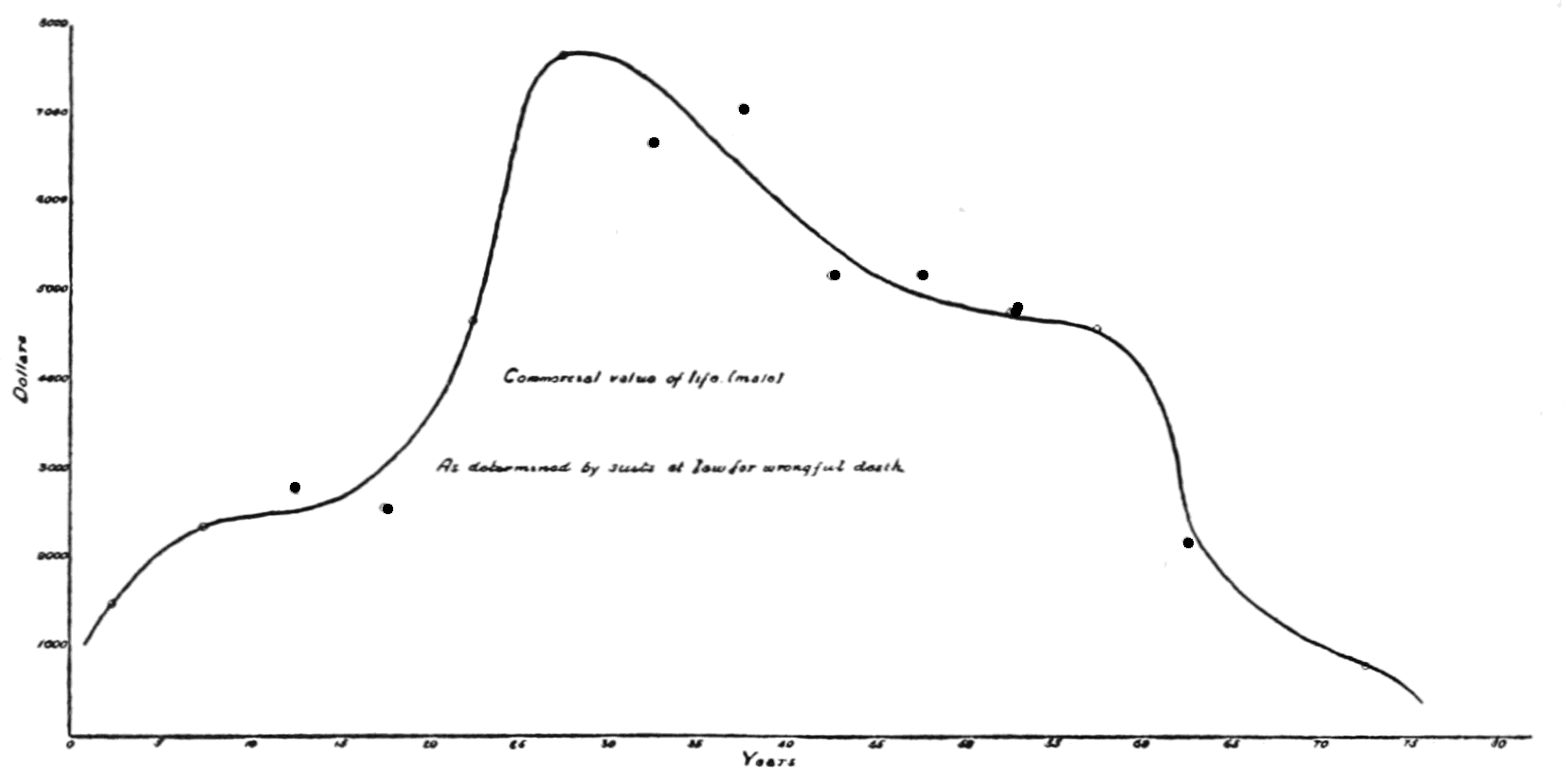
PSM V61 D130 The value of human life.png
from "The Commercial Value of Human Life"
By Marshall O. Leighton
Popular Science Monthly; June, 1902 http://tinyurl.com/qyhc8do
 
There is now a substantial economics literature that estimates the VSL from labor market decisions. Controlling for other aspects of the job, how much pay do workers get for incurring extra risk?  In some instances, the risks workers face are substantial. Fictional characters such as Jack Bauer in the television antiterrorism series represent extreme examples of risk. Coal miners and deep sea fisherman are nonfictional examples of workers who incur relatively large risks. Although such dramatic risks are not the norm, few workers’ jobs are risk-free. In my early studies of VSL using data from the 1970s, the average annual worker fatality rate from job-related risks was 1=10,000.  At present, the annual worker fatality risk averages about 1=25,000.  The trade-offs for facing risk are sometimes explicit. For example, elephant handlers  in  the  Philadelphia  Zoo  received  an  annual  wage  premium  of  $1,000 because  elephants  pose  the  greatest  risk  to  zookeepers.  Firefighters  who  battled  the  fires  in  Kuwait  received  $500,000  per  year.  More  typically,  workers receive a modest premium for the relatively low risks that they face on the job.... One can also estimate the cost–risk trade-off from product choices. The switch to  smaller, more fuel efficient vehicles has killed thousands of  motorists,  but  in  return  for  these  greater  risks  consumers  have  reduced  their gas bills.

The average VSL based on the revealed preferences in the labor market yields a U.S. value of about  $9 million. Thus, a worker facing a risk of death of 1=10,000, as in our example above, requires $900 in extra pay per year to face this risk. For the current average annual death risk of 1=25,000, the additional wage compensation is $360.... There is substantial heterogeneity in the VSL with workers in high risk jobs having a VSL far below $9 million and workers in lower risk jobs having a VSL of $20 million or more....

Monday, December 28, 2015

Registration Open for 8th Annual Conference and Meeting of the Society for Benefit Cost Analysis March 16-18, 2016, Washington DC

The Society for Benefit-Cost Analysis (SBCA) is an international group of practitioners, academics and others who are working to improve the theory and application of the tools of benefit-cost analysis.  

Conference papers address the link between theory and practice, the methods used to estimate particular types of costs or benefits, the application of BCA to specific case studies, the role of BCA in decision making, or any other relevant topic. Attendees and presenters include a mix of scholars, practitioners, and others working in academia, nonprofits, business and government around the world.

To register go to http://tinyurl.com/zy4ray8.  Early bird rates are available through January 31, 2015

Primary sponsorship of the 2016 conference is provided by the John D. and Catherine T. MacArthur Foundation. Additional sponsors include: the GW Regulatory Studies Center and Stata Corp LP.

The Conference will be held at The Marvin Center at the George Washington University 800 21st St. NW, Washington, D.C. 20052.  A block of rooms has been reserved at One Washington Circle Hotel, four blocks from the conference location and less than two blocks from the Foggy Bottom Metro station.

For additional information about the Society for Benefit Cost Analysis, other events, previous conferences and the Journal of Benefit Cost Analysis go to: http://benefitcostanalysis.org/

Sunday, December 27, 2015

Modeling the Effects of Refinery Emissions on Residential Property Values

Abstract
We examined the effects of refinery air pollution on house prices near Houston, Texas. The affected  area was identified through AERMOD air modeling of past releases of sulfur dioxide, a proxy for  respiratory risk. A total of 3,964 residential MLS sales from 2006 to 2011 were used to populate an OLS model, a spatial model, and a spatial model with an additional endogenous variable. The findings indicate that air pollution has a significant negative 6%–8% loss on house prices. For one year, the negative effect is shown to generally diminish with distance up to about two miles from the refinery.
by Robert A. Simons 1, Youngme Seo 2 and Paul Rosenfeld 3
1. Cleveland State University, Email: r.simons@csuohio.edu
2. Univ.of. Arkansas-LR
3. SWAPE, LA, CA
Journal of Real Estate Research (JRER) a publication of the American Real Estate Society (ARES) http://pages.jh.edu/jrer/
Volume 37, Number 3, 2015
The full paper is available free of charge at http://pages.jh.edu/jrer/papers/abstract/new_current/av37n03/vol37n03_01.html