Showing posts with label Models. Show all posts

Sunday, January 25, 2026

Trends and Biases in the Social Cost of Carbon

Richard Tol provides an updated meta-analysis of the social cost of carbon (SCC), a central statistic used to justify climate policies by measuring the benefit of reducing CO2 emissions. The study explores how various ethical assumptions and model parameters, such as the pure rate of time preference, influence the final estimates. Tol notes that the literature is dominated by a relatively small, concentrated network of authors from a few specific countries. This concentration may introduce publication and citation biases that have historically pushed SCC estimates upward. The paper aims to refine the meta-database to provide a more accurate characterization of uncertainty in these economic projections.

The meta-analysis confirms that while SCC estimates have trended upward over time, they are characterized by a large and right-skewed uncertainty. This "thick tail" in the distribution means there is a non-negligible possibility of extremely high costs. Interestingly, the study finds that the social cost is much higher when climate change is assumed to affect economic growth rates rather than just the levels of output and welfare. Tol argues that while the total impact of a 2.5 °C warming is a factor, it is less influential than the underlying ethical views and discount rates chosen by researchers. The findings suggest a need for more diverse perspectives in the production of these influential climate-economy figures.

The central estimate of the social cost of carbon identified in this updated meta-analysis is approximately $200–250 per ton of carbon. When converted to carbon dioxide, this range equates to $700–900 per tCO2. The study specifically looks at the economic impact of a 2.5 °C warming as a benchmark for comparison. Furthermore, Tol examines the influence of citation networks, noting that the field's focus on a "small network of authors" can lead to biases that have pushed the social cost up beyond what a broader literature might suggest. These values provide a stark contrast to the lower estimates often used in older government policy assessments.

Tol, Richard S. J. "Trends and Biases in the Social Cost of Carbon." *Annals of the New York Academy of Sciences* (2025). https://doi.org/10.1111/nyas.15340

Projected Effects of the Clean Competition Act of 2025

This report analyzes the projected impacts of the Clean Competition Act (CCA), which proposes a domestic performance standard and a carbon border adjustment mechanism (CBAM) for energy-intensive goods. Using the Global Economic Model (GEM), the authors assess how carbon fees on US manufacturers and analogous tariffs on imports would influence trade, revenues, and emissions. The policy is designed to incentivize lower emissions intensity by taxing carbon levels above a set industry benchmark. The findings suggest that the CCA would shift US imports toward less carbon-intensive countries, such as the UK and Japan, while reducing imports from higher-intensity producers like China, Mexico, and India.

The CCA is projected to significantly reduce global greenhouse gas emissions, with the United States leading the reductions through both improved manufacturing efficiency and decreased demand for energy-intensive goods. While the policy raises substantial government revenue, it also results in slightly lower domestic production in covered sectors like aluminum, steel, and cement due to increased costs for higher-intensity producers. The report notes that the tariffs provide a protective effect for cleaner US manufacturers, but the overall balance of effects leads to small declines in output across most covered and downstream industrial sectors.

Key projections and economic impacts include:

* Global emissions are projected to decrease by 81 million metric tonnes (MMt) in the first year, with US reductions accounting for 63 MMt.

* By the tenth year of the policy, annual global emissions reductions are projected to reach 140 MMt, with US reductions at 119 MMt.

* Total government revenue is projected to be $7.2 billion in the first year and reach $101 billion over the first ten years.

* Domestic output in covered sectors is projected to fall slightly, including cement by -0.02 percent, aluminum by -1.9 percent, and iron and steel by -0.6 percent.

* The policy results in a 0.6 percent output tax equivalent for domestic petroleum refining, contributing to a 0.3 percent rise in imports from zero-tariffed countries.

Rennert, Kevin, Mun Ho, Katarina Nehrkorn, and Milan Elkerbout. *Projected Effects of the Clean Competition Act of 2025*. Report 25-19. Washington, DC: Resources for the Future. December 2025. https://www.rff.org/publications/reports/projected-effects-of-the-clean-competition-act-of-2025/

Wednesday, June 14, 2023

Life Cycle Air Pollution, Greenhouse Gas, and Traffic Externality Benefits and Costs of Electrifying Uber and Lyft

Abstract 
Transportation network companies (TNCs), such as Uber and Lyft, have pledged to fully electrify their ridesourcing vehicle fleets by 2030 in the United States. In this paper, Aniruddh Mohan, Matthew Bruchon, Jeremy Michalek, and Parth Vaishnav introduce AgentX, a novel agent-based model built in Julia for simulating ridesourcing services with high geospatial and temporal resolution.  The authors then instantiate this model to estimate the life cycle air pollution, greenhouse gas, and traffic externality benefits and costs of serving rides based on Chicago TNC trip data from 2019 to 2022 with fully electric vehicles. They estimate that electrification reduces life cycle greenhouse gas emissions by 40–45% (9–10¢ per trip) but increases life cycle externalities from criteria air pollutants by 6–11% (1–2¢ per trip) on average across our simulations, which represent demand patterns on weekdays and weekends across seasons during prepandemic, pandemic, and post-vaccination periods. A novel finding of their work, enabled by their high resolution simulation, is that electrification may increase deadheading for TNCs due to additional travel to and from charging stations. This extra vehicle travel increases estimated congestion, crash risk, and noise externalities by 2–3% (2–3¢ per trip). Overall, electrification reduces net external costs to society by 3–11% (5–24¢ per trip), depending on the assumed social cost of carbon.
by Aniruddh Mohan, Matthew Bruchon, Jeremy Michalek, and Parth Vaishnav 
Environmental Science & Technology https://pubs.acs.org/journal/esthag via ACS https://pubs.acs.org
Volume 57, Issue 23, pages 8524–8535; Publication Date: June 1, 2023

Tuesday, May 23, 2023

New damage curves and multimodel analysis suggest lower optimal temperature

Abstract:
Economic analyses of global climate change have been criticized for their poor representation of climate change damages. Here we develop and apply aggregate damage functions in three economic Integrated Assessment Models (IAMs) with different degrees of complexity. The damage functions encompass a wide but still incomplete set of climate change impacts based on physical impact models. [The authors] show that with medium estimates for damage functions, global damages are in the range of 10% to 12% of GDP by 2100 in a baseline scenario with 3 °C temperature change, and about 2% in a well-below 2 °C scenario. These damages are much higher than previous estimates in benefit-cost studies, resulting in optimal temperatures below 2 °C with central estimates of damages and discount rates. Moreover, [they] find a benefit-cost ratio of 1.5 to 3.9, even without considering damages that could not be accounted for, such as biodiversity losses, health and tipping points.
Fig. 1: Overview of the creation and use of the damage functions.

Fig. 2: End-of-century damages for the five macro-regions for two scenarios.


by Kaj-Ivar van der Wijst, Francesco Bosello, Shouro Dasgupta, Laurent Drouet, Johannes Emmerling, Andries Hof, Marian Leimbach, Ramiro Parrado, Franziska Piontek, Gabriele Standardi & Detlef van Vuuren 
Nature Climate Change https://www.nature.com Volume 13, Pages 434–441 (2023)

Sunday, May 21, 2023

Policies, Projections, and the Social Cost of Carbon: Results from the DICE-2023 Model

Abstract
The present study examines the assumptions, modeling structure, and preliminary results of DICE-2023, the revised Dynamic Integrated Model of Climate and the Economy (DICE), updated to 2023. The revision contains major changes in the carbon and climate modules, the treatment of non-industrial greenhouse gases, discount rates, as well as updates on all the major components. The major changes are a significantly lower level of temperature of the cost-benefit optimal policy, a lower cost of reaching the 2° C target, an analysis of the impact of the Paris Accord, and a major increase in the estimated social cost of carbon.
...
Table 7 and Figure 7 show estimates of the social cost of carbon (SCC). The SCC in the baseline run is $61/tCO2 for the 2020 period (in 2019 international $). This is above the SCC for the C/B (Cost/Benefit) optimal run of $53/tCO2 because damages are smaller in the C/B optimum. It is far below the SCC for the 2 °C run of $85/tCO2. The higher SCC in the temperature-limited run reflects the economic interpretation that a tight temperature limit is equivalent to a damage function with a sharp kink at the temperature limit and therefore to a sharply higher damage function above 2 °C. Note that the estimates of the SCC in the current DICE version are significantly above those in earlier vintages for reasons discussed in other sections, see particularly the next section. 

One of the most instructive findings involves the importance of discounting for the SCC and other policies. Table 7 shows the powerful impact of discounting on the SCC. The social cost of carbon at a 5% discount rate is two-thirds of the DICE C/B optimal estimate for 2020, while that of a 1% discount rate is 8 times the DICE C/B optimal estimate for 2020.
Additionally, Figure 8 compares estimates of the SCC with several other current values. The GIVE model is a comprehensive estimate prepared by researchers at Resources for the Future using probabilistic estimates of output and other components of damage estimates (Rennert et al., 2022). It uses a relatively low discount rate and has a relatively high social cost of carbon. A second set of estimates pertains to the SCC used by the federal government and prepared by an interagency working group. Figure 8 shows draft SCC estimates from EPA (2022) for both their overall assessment and specific to a damage module based on the DSCIM model (Climate Impacts Lab, 2022) for near-term discount rates from 1.5% to 2.5%. Conditional on discounting assumptions, the EPA estimates align very closely with those of DICE-2023. Figure 8 also shows a draft update (OMB, 2021) based on earlier methods and models which did not contain recommended methodological updates. This estimate is notably lower than the corresponding value in DICE-2023. The key takeaway from Figure 8 is the importance of the discount rate in determining the SCC.

A major change in the results of the DICE model over the years has been the rising estimates of the social cost of carbon. The original DICE-1992 model did not calculate a SCC, which came later to climate-change economics. However, rerunning the baseline scenario for the 1992 model gives an estimate of $18/tCO2 compared to $61/tCO2 in the 2023 model (in 2019$). The upward revision is a notable illustration of the evolving scientific understanding of damages, discount rates, and levels of output. Further research will provide a decomposition of the sources of the change in SCC due to different components.

by Lint Barrage & William D. Nordhaus
National Bureau of Economic Research (NBER) www.NBER.org
Working Paper 31112; Issue Date: April, 2023

Tuesday, January 18, 2022

An Analysis of US Subsidies for Electric Buses and Freight Trucks

... Congress may create entirely new subsidies for commercial electric vehicles and associated charging infrastructure included in both the Clean Energy for America Act and the Build Back Better Act. This issue brief analyzes the carbon dioxide (CO2) reductions and fiscal costs of subsidies for transit buses and certain trucks.

Medium- and heavy-duty vehicles (that is, anything larger than a passenger vehicle) consume roughly 30 percent of the total energy used by on-road or “highway” vehicles and generate about one-quarter of GHG emissions from the transportation sector (equivalent to 7 percent of total US emissions). 

... The fiscal costs and GHG reductions of the electric truck subsidies will depend on how much truck buyers respond to the subsidies and how much those trucks are driven, but because these subsidies are brand new, it is that much harder to anticipate their effects and assess how much the subsidies may help achieve the Biden administration’s climate objectives.

Joshua Linn and Wesley Look study the potential effects of offering tax credits to transit buses, day cabs (freight trucks that do not include a sleeping compartment), and sleeper cabs (freight trucks that include a sleeping compartment). The three vehicle categories account for almost half of carbon dioxide (CO2) emissions from medium and heavy-duty vehicles (MHDVs), with sleeper cabs making the largest contribution of the three types. 

They analyze a subset of the vehicle types that are eligible for subsidies, and are not estimating the total effect of the policies on all MHDVs.

They use a new computational model of MHDVs that accounts for the effects of subsidizing 30 percent of the up-front purchase cost of transit buses, day cabs, and sleeper cabs to estimate the uptake, fiscal costs, and CO2 benefits of the subsidies through 2035, relative to a baseline case that does not include the subsidies. They consider scenarios that differ by the rate at which electric vehicle prices decline over time; in all scenarios, the subsidy phases out after electric vehicles achieve 50 percent market share.

Their key findings are:
1. In the baseline case (no subsidies), electric buses, day cabs, and sleeper cabs are unlikely to achieve significant shares of new purchases by 2035.
2. The effectiveness of the 30 percent subsidy at increasing electric bus and truck sales depends on the assumed rate at which electric vehicle prices decline. Assuming a moderate rate of pre-subsidy price decline, the subsidy causes electric bus, day cab, and sleeper cab sales to begin increasing around 2030 and achieve a 50 percent market share in 2035.
3. Assuming a faster rate of price decline, the subsidy causes electric buses, day cabs, and sleeper cabs to achieve a combined 80 percent market share by 2035. At a faster rate of price decline, the subsidy reduces emissions by about 60 million metric tons of CO2 in 2035, which amounts to about a 60 percent decrease in emissions relative to the baseline (no subsidy) scenario.

Figure 1. Total Sales (number of new EV trucks sold per year

Total (undiscounted) fiscal costs between 2022 and 2031 are $2-24 billion, depending on the degree of price decline, with faster decline causing greater uptake and higher fiscal cost. Fiscal costs per ton of CO2 reduction are broadly comparable to recent estimates for subsidizing plug-in electric light-duty vehicles.

Note that the Biden administration’s target is for total US GHG emissions in 2030 to equal half of total emissions from 2005. The emissions reduction in 2030 for transit buses, day cabs, and sleeper cabs in the high-technology scenario amounts to 1.4 percent of the total emissions reduction needed to achieve that target. 
...
An individual buyer considering either a bus or cab trades off up-front purchase costs against fuel and maintenance costs. For example, they assume that an all-electric bus has a purchase price of about $185,000 in 2030 (not including subsidies), which is almost 50 percent higher than the price of a diesel bus.
Figure 3. Percent of Electric Buses and Trucks on the Road

Tuesday, January 12, 2021

The Benefits and Costs of Decarbonizing Costa Rica's Economy

Costa Rica's National Decarbonization Plan (NDP) sets the ambitious goal for the country to become carbon-neutral by 2050 and lays out a wide range of policy and institutional reforms to achieve this goal. The authors of this report developed an integrated model that estimates the benefits and costs of implementing the NDP in all major sectors, informed by consultations with numerous government agencies, industries, and nongovernmental organizations, and used it to evaluate whether the NDP makes economic sense for Costa Rica — that is, whether the benefits of the NDP exceed its costs.

The authors' analysis suggests that under the vast majority of plausible assumptions about the future, the NDP would achieve or nearly achieve its greenhouse gas emissions reduction goals and do so at a net economic benefit. Conversely, without a concerted focus and investment in decarbonization, Costa Rica's greenhouse gas emissions will increase substantially.


The findings from this study can play an important role in ensuring that the implementation of the NDP is robust — meaning that it will achieve its goals in the uncertain future. This analysis confirms which lines of action are most critical to the success of the NDP — transport and land use — and identifies some key conditions necessary to achieve close to zero net emissions at a large net economic benefit. This study also offers ideas and models that are valuable for other countries interested in decarbonization, and that can inspire development partners globally.

Key Findings
  • Under baseline assumptions, decarbonization would yield $41 billion in net benefits to Costa Rica between 2020 and 2050, using a 5 percent discount rate.
  • Under all but 22 of the more than 3,000 plausible futures considered, implementation of the decarbonization plan would lead to economic benefits that exceed the costs.
  • Currently, electricity is almost completely renewable, and with modest investments it would provide nearly emissions-free energy to support the electrification of much of Costa Rica's economy.
  • In the transport sector, significant emissions reductions are possible through electrification of transport and shifting to public transportation. The economic benefits from energy savings, fewer accidents, time saved from reduced congestion, and the reduced negative impacts of air pollution on health more than compensate for the initially higher up-front costs of switching to electric vehicles and building infrastructure for zero-emissions public transport.
  • Reducing emissions in agriculture and livestock could lead to increased productivity, and increasing carbon sequestration by forests would increase valuable ecosystem services, such as renewable forestry products, water and soil benefits, and support for tourism and cultural heritage.
  • Emissions reductions from buildings, industry, and the waste sector are also important to reach zero net emissions and together provide modest net benefits through energy cost savings, increased productivity, and the value of treating and recycling and reusing liquid and solid waste.

Recommendations
  • Costa Rica should continue implementing its NDP to both meet its international obligations to decarbonize and facilitate an economic transition that would very likely lead to large net benefits and contribute to a sustainable COVID-19 pandemic recovery.
  • As Costa Rica recovers from the COVID-19 pandemic, it should focus on decarbonization investments that would reactivate the economy and provide support to the most critically affected sectors of the economy.
  • Costa Rica should monitor the costs of alternative-fuel vehicles, as well as the adoption of improved public transportation options, and make adjustments to the transport decarbonization strategies as needed to ensure net economic benefits and sufficient emissions reductions.
  • As Costa Rica continues to manage its forests for long-term sustainability, it should measure and monitor ecosystem service benefits in order to best target the NDP interventions.
  • Costa Rica should continue to develop more-detailed proposals for implementing the plan and reevaluate benefits and costs periodically to ensure the greatest net benefits, including by aligning its Nationally Determined Contribution to the NDP.
...
Our analysis suggests that, under baseline assumptions, implementing the NDP would lead to net-zero GHG emissions by 2050 and provide about $41 billion of net benefits across the economy from 2020 to 2050, discounted back to 2015 at a rate of 5 percent per year.3 It would save or otherwise provide $78 billion in benefits, and it would cost about $37 billion. There is significant uncertainty around these estimates, but the analysis shows that under the vast majority of plausible assumptions about the future, the NDP would achieve or nearly achieve its emissions reduction goals and do so at a net economic benefit.

Under baseline assumptions, fully implementing all lines of action in the NDP would lead to about $41 billion in net benefits (Figure S.2). The greatest benefits are due to actions affecting transport,  agriculture, livestock, and forestry net emissions. In the agriculture, livestock, and forestry sectors, ecosystem services provided by forests, such as renewable forestry products, water and soil benefits, support for tourism and cultural heritage, and improved yields are worth much more than the investments required to decarbonize and the forgone value of land dedicated to forests—providing discounted net benefits of about $22 billion. The public and private transport sectors together with the freight sector would provide $19 billion in net benefits under baseline assumptions, since the economic benefits from energy savings, fewer accidents, time saved from reduced congestion, and the reduced negative impacts of air pollution on health more than compensate for the initially higher up-front costs of switching to electric vehicles and building infrastructure for public transport (Godínez-Zamora et al., 2020). Efficiency gains in industry, and the economic value of recycled materials and treated wastewater, result in a small net benefit for the industry and waste sectors: $1.3 billion together. Figure S.2 shows modest net costs for the electricity and buildings lines of actions. However, the benefits of cheaper electricity are accounted for under the transport, industry, and buildings sectors.

by David G. Groves, James Syme, Edmundo Molina-Perez, Carlos Calvo Hernandez, Luis F. Víctor-Gallardo, Guido Godinez-Zamora, Jairo Quirós-Tortós, Felipe De León, Andrea Meza Murillo, Valentina Saavedra Gómez, Adrien Vogt-Schilb
 

Friday, January 8, 2021

Local Sectoral Specialization in a Warming World

Abstract:
This paper quantitatively assesses the world's changing economic geography and sectoral specialization due to global warming. It proposes a two-sector dynamic spatial growth model that incorporates the relation between economic activity, carbon emissions, and temperature. The model is taken to the data at the 1° by 1° resolution for the entire world. Over a 200-year horizon, rising temperatures consistent with emissions under Representative Concentration Pathway 8.5 push people and economic activity northwards to Siberia, Canada, and Scandinavia. Compared to a world without climate change, clusters of agricultural specialization shift from Central Africa, Brazil, and India's Ganges Valley, to Central Asia, parts of China and northern Canada. Equatorial latitudes that lose agriculture specialize more in non-agriculture but, due to their persistently low productivity, lose population. By the year 2200, predicted losses in real GDP and utility are 6% and 15%, respectively. Higher trade costs make adaptation through changes in sectoral specialization more costly, leading to less geographic concentration in agriculture and larger climate-induced migration.
...


Sunday, January 3, 2021

Reaching Net Zero Emissions In Virginia Could Increase State GDP More Than $3.5 Billion Per Year

When Governor Ralph Northam signed the Virginia Clean Economy Act (VCEA) into law this April, the state joined the vanguard of U.S. states enacting ambitious policy to transition from fossil fuels to a clean energy economy. But while the VCEA would significantly decarbonize Virginia’s power sector by 2050, it will still fall short of the emissions reductions needed for a safe climate future.

New modeling using the Virginia Energy Policy Simulator (EPS), developed by Energy Innovation and Rocky Mountain Institute, estimates the VCEA will reduce power sector emissions nearly 64% and cut economy-wide emissions 26% by 2050 compared to business-as-usual. While the VCEA puts Virginia on the path to significant decarbonization, it does not cover the rest of the state’s economic sectors, and falls short of the Intergovernmental Panel on Climate Change’s recommended pathway to limit warming to 1.5° Celsius for a safe climate future.
...
[The general Energy Policy Simulator available for other regions is available at https://us.energypolicy.solutions/ and more fully described  in a blog post at https://tinyurl.com/yajhwfw7 ]
Percent GDP Change in a Net Zero Scenario - U.S.
... A more ambitious policy package that implements climate policies across the transportation, buildings, industrial, land, and agricultural sectors could put Virginia on a 1.5°C pathway and generate massive economic benefits: By 2050, this scenario could achieve net-zero emissions, generate more than 12,000 job-years, and increase state GDP by more than $3.5 billion per year.

Virginia’s second-largest source of emissions is the electricity sector. Before the VCEA was enacted, the state’s power sector emissions were projected to grow from roughly 30 million metric tons of carbon dioxide-equivalent (MMT CO2e) in 2019 to about 35 MMT CO2e in 2050.

The VCEA will spur significant electricity sector emissions reductions by requiring the state’s investor-owned utilities to decarbonize, including requiring Dominion to achieve 100 percent carbon-free electricity by 2045 and Appalachian Power to achieve 100 percent carbon-free electricity by 2050. It also requires closing nearly all coal-fired power plants by 2024 and most natural gas, biomass, and petroleum-fired power plants by 2045.

The VCEA would also [increase] Virginia’s renewable energy industry with targets for 5,200 megawatts (MW) of offshore wind by 2034, 3,100 MW of energy storage capacity by 2035, and significant energy efficiency growth....Virginia currently has 2,300 MW of installed renewable energy capacity....
...
Transportation is the largest current source of statewide emissions, followed by industry and buildings as the third- and fourth-largest greenhouse gas contributors....

Modeling of the VCEA and 1.5°C pathway was conducted using the open-source and peer reviewed Virginia EPS computer model, which allows users to estimate climate and energy policy impacts on emissions, the economy, and public health.... 

This policy package would reduce economywide emissions 63% below 2005 levels by 2030 and achieve net-zero emissions before 2050.... In addition to the economic benefits, the scenario would reduce harmful air pollution, creating health benefits for Virginians.

... The Virginia EPS ... [requires] all new passenger cars sold to be electric by 2035, and all new trucks to be electric by 2045. This standard aligns with California’s transportation sector policies and the multi-state Memorandum of Understanding on moving to zero emissions medium and heavy duty vehicles that 17 states follow. The scenario also includes investing in alternatives to passenger car travel, with supportive land use and transportation policies that empower people to use public transit or walk and bike, resulting in a 20% passenger car travel reduction by 2050.

In the buildings sector, a sales standard requiring all newly sold building equipment to be electric by 2030 would shift gas space and water heating systems to all-electric heat pumps, which are already commercially available and common in many parts of the U.S. Strong efficiency standards (potentially state standards on new equipment sales, a utility rebate program, or a statewide energy efficiency resource standard) further improve the efficiency of newly sold building equipment.

The Virginia EPS 1.5°C pathway ...covers the entire electricity sector (including municipal and cooperative utilities) and targets 100% clean power [earlier], by 2035. The VCEA’s offshore wind, energy storage, and power plant closure requirements are also included along with additional policies to expand the transmission system, spur demand response, and add even more storage for valuable grid flexibility.

Virginia’s industry sector emissions come from [leaks].... To reduce energy-related emissions, the scenario requires industrial facilities electrify all end-uses where possible, to switch to a zero-carbon fuel (in this case hydrogen) for all others by 2050, and for the hydrogen to be produced through the zero-carbon process known as electrolysis. Policies promoting more efficient use of industrial materials and improved industrial energy efficiency achieve additional reductions.
...
By 2050, this scenario would generate more than 12,000 job-years and increase Virginia’s GDP by more than $3.5 billion per year.

Moving away from fossil fuels also improves air quality by reducing particulate matter emissions and other pollutants that harm human health – [avoiding] more than 16,000 asthma attacks per year by 2050.
...
by Silvio Marcacci, Communications Director at Energy Innovation a nonpartisan climate policy think tank helping policymakers make informed energy policy choices and accelerate clean energy by supporting the policies that most effectively reduce greenhouse gas emissions.
FOR FULL STORY GO TO:
December 9, 2020
Also see Greentech Media's coverage at https://tinyurl.com/y7zvgj8y

Tuesday, October 27, 2020

Net zero emissions target for Australia could launch $63bn investment boom - Modelling shows moving towards a net zero emissions economy would unlock financial prospects in sectors including renewables and manufacturing

Australia could unlock an investment boom of $63bn over the next five years if it aligns its climate policies with a target of net zero emissions by 2050, according to new economic modelling.

The analysis, by the Investor Group on Climate Change (IGCC), finds the investment opportunity created by an orderly transition to a net zero emissions economy would reach hundreds of billions of dollars by 2050 across sectors including renewable energy, manufacturing, carbon sequestration and transport.

However, if the country keeps to its current targets and climate policies, investment worth $43bn would be lost over the next five years, growing to $250bn by 2050.

The Investor Group on Climate Change represents investors in Australia and New Zealand who are focused on the effect of the climate crisis on the financial value of investments.  The organisation commissioned the consultancy Energetics to examine the domestic investment opportunities that would arise from an orderly transition to net zero emissions by 2050.

The report finds a net zero scenario would unlock $63bn in investment over the next five years, including $15bn in manufacturing, $6bn in transport infrastructure such as charging stations, and $3bn in domestic green hydrogen production, as companies and governments moved towards the stronger emissions goal.

Carbon sequestration – or carbon farming – would emerge as a major investment asset class, with estimated investment worth $33bn in nature-based solutions such as tree planting and assisted regeneration of deforested land.
Windy Hill Wind Farm, Atherton Tablelands, Queensland
https://en.wikipedia.org/wiki/Renewable_energy_in_Australia

The investment potential would reach hundreds of billions of dollars over the longer term to 2050, including $385bn in clean electricity, $350bn in domestic green hydrogen, $104bn in transport infrastructure and $102bn in carbon sequestration.

“What it shows is that the investment opportunities extend well beyond just the renewables industry,” said Erwin Jackson, the IGCC’s director of policy.  “Renewables are the backbone of the transition but there are massive opportunities in other sectors such as manufacturing, restoring the land, and electrification of transport.”

The report, which targets governments, companies, investors and financial regulators, says its estimates are conservative because they do not factor in the export potential of industries such as clean hydrogen.
It argues that if governments set stable policy, and companies and investors collaborate to align their decisions with the goals of the Paris agreement, then billions of dollars over the short and long term could support the jobs and wealth of millions of Australians, particularly in regional areas.

The Morrison government has refused to commit Australia to a net zero emissions target and has focused its climate policy on a new technology roadmap covering hydrogen, energy storage, “low carbon” steel and aluminium, carbon capture and storage, and soil carbon.  Under the roadmap, the government claims it will invest $18bn in technologies over 10 years.

The IGCC report notes that more than half of Australia’s two-way trading partners have set targets to reach net zero emissions by mid-century.
https://tinyurl.com/y6yzlt7m

Morrison's rejection of 2050 net zero emissions target is at odds with Paris agreement, experts say

It warns that a business as usual “hothouse” scenario in Australia – with no net zero emissions target – would produce $43bn less in investment over five years and $250bn less by 2050 than what would be possible with a net zero target.

“Put bluntly, capital is global and it wants to invest in climate change solutions because they see it as delivering more on their long term investments,” Jackson said. “They’re going to invest more in countries that have durable, credible policies to achieve net zero emissions by 2050.”

John Connor, the chief executive of the Carbon Market Institute, said the reality Australia faced was its economy was running “below capacity and it needs a new direction”.  He said clean technologies like renewable energy and transport represented significant opportunities for Australia in a post-carbon world and the country’s vast land mass, with landscapes in need of regeneration, gave it a competitive advantage in carbon sequestration.
...
by Lisa Cox
The Guardian www,Guardian.com
13 Oct 2020

Monday, October 26, 2020

Finding the Right Policy Mix to Safeguard our Climate

Unaddressed, climate change will entail a potentially catastrophic human and economic toll, but it’s not too late to change course.  Global temperatures have increased by about 1°C since the pre-industrial era because of heat-trapping green-house gases accumulating in the atmosphere. Unless strong action is taken to curb emissions of these gases, global temperatures could increase by an additional 2–5°C by the end of this century. Keeping temperatures to levels deemed safe by scientists requires bringing net carbon emissions to zero on net globally by mid-century.  Economic policy tools can pave a road toward net zero emissions by 2050 even as the world seeks to recover from the COVID-19 crisis.

In the latest World Economic Outlook we make the case that economic policy tools can pave a road toward net zero emissions by 2050 even as the world seeks to recover from the COVID-19 crisis. We show that these policies can be pursued in a manner that supports economic growth, employment and income equality.

The manageable costs of mitigation
Economic policies can help address climate change through two main channels: by affecting the composition of energy (high- vs. low-emission sources), and by influencing total energy usage. The costs and benefits of different policies are determined by how they exploit these distinct channels.
For example, a carbon tax makes dirty fuels more expensive, which incentivizes energy consumers to shift their consumption towards greener fuels. Total energy consumption falls too because, overall, energy is more expensive.

In contrast, policies that aim to make green energy cheaper and more abundant (subsidies or direct public investment in green energy) increase the share of low-emissions energy. However, by making energy cheaper overall, green energy subsidies continue to stimulate total energy demand or at least do not reduce it.

In line with this intuition, our latest analysis suggests pairing carbon taxes with policies that cushion the impact on consumers’ energy costs can deliver rapid emissions reductions without major negative impacts on output and employment. Countries should initially opt for a green investment stimulus—investments in clean public transportation, smart electricity grids to incorporate renewables into power generation, and retrofitting buildings to make them more energy efficient.

This green infrastructure push will achieve two goals.

First, it will boost global GDP and employment in the initial years of the recovery from the COVID-19 crisis. Second, the green infrastructure will increase productivity in low-carbon sectors, thereby incentivizing the private sector to invest in them and making it easier to adapt to higher carbon prices.
Our model-based scenario analysis suggests that a comprehensive policy strategy to mitigate climate change could boost global GDP in the first 15 years of the recovery by about 0.7 percent of global GDP on average, and employment for about half of that period leading to about 12 million extra persons being employed globally. As the recovery takes hold, preannounced and gradually rising carbon prices will become a powerful tool to deliver the needed reduction in carbon emissions.

If implemented, such a policy program would put the global economy on a sustainable path by reducing emissions and limiting climate change. The net effect would approximately halve the expected output loss from climate change and provide long-term, real GDP gains well above the current course from 2050 onward.

Transition costs
Despite the long-run benefits, and an initial boost to economic activity, such policies do impose costs along the transition. Between 2037–50, the mitigation strategy would hold global GDP down by about 0.7 percent on average each year and by 1.1 percent in 2050 relative to unchanged policies. These costs seem manageable, however, considering that global output is projected to grow by 120 percent between now and 2050. The drag on output could be further reduced if climate policies incentivize technological development in clean technologies—through R&D subsidies, for instance. Moreover, the package would be neutral for output during that period if important benefits in the form of better health outcomes (due to reduced pollution) or less traffic congestion are considered.
The transitional output costs associated with the policy package vary significantly across countries. Some of the advanced economies may experience smaller economic costs or even see gains throughout the transition. Given their earlier investments into renewables, these economies can more easily ramp up their use and avoid large adjustment costs. Countries with fast economic or population growth (India, especially) and most oil producers should expect larger economic costs by forgoing cheap forms of energy, such as coal or oil. Yet these output costs remain small for most countries and need to be weighed against avoided climate change damages and the health benefits from reducing the use of fossil fuels.

Saturday, October 17, 2020

Carbon Tax Adjustment Mechanisms (TAMs): How They Work and Lessons from Modeling - Tax adjustment mechanisms can significantly decrease emissions uncertainty under a carbon tax while only modestly increasing the cost of emissions reductions.

Carbon taxes can provide powerful incentives for businesses and households to reduce greenhouse gas emissions. Setting a tax, however, does not on its own guarantee a particular level of future emissions because it is impossible to predict exactly how a complex economy will respond to any given price level. To provide greater assurance about environmental performance, environmental integrity mechanisms (EIMs) can be built into carbon tax legislation. These innovative provisions have already been included in several recent US carbon tax proposals, including the MARKET CHOICE Act and the Energy Innovation and Carbon Dividend Act (both introduced in the 115th Congress and updated and reintroduced in the 116th Congress) and the Stemming Warming and Augmenting Pay (SWAP) Act and the Climate Action Rebate Act (both introduced in the 116th Congress). 

This brief focuses on one type of EIM, a Tax Adjustment Mechanism (TAM), by which the carbon tax price path is automatically adjusted if actual emissions do not meet specified emissions reduction goals. As the TAM concept gains acceptance by the policy community and Congress, research and analysis are needed to evaluate how different TAM designs will affect emissions and economic outcomes. For example, how frequently should a tax adjustment be triggered—on the basis of annual or cumulative emissions, or both? How large should the adjustment be? And how far from a desired trajectory must emissions be before it is triggered? These design choices should be grounded in rigorous analysis with an understanding of their implications for environmental performance and cost.

In response to this critical need, Resources for the Future (RFF), in collaboration with Environmental Defense Fund (EDF), has developed new modeling capacity designed to quantify the range of emissions uncertainty in carbon taxes and to evaluate the effectiveness of different TAM designs. This analysis finds that TAMs can significantly reduce emissions uncertainty and increase the probability of hitting particular emissions targets—often with very modest cost increases—but design details matter considerably in terms of both effectiveness and efficiency.

Coal Plant https://en.wikipedia.org/wiki/Carbon_tax

Results suggest that a TAM can reduce emissions uncertainty in several ways:

by reducing the likelihood of very high emissions outcomes;
by reducing expected emissions and the range of potential expected emissions; and/or
by increasing the probability of meeting a specific emissions target.

This reduced uncertainty comes at a potential cost. By increasing the price if emissions goals are not met, TAMs generally increase expected costs of abatement. 6 These cost increases, however, are often quite modest compared with the reduction in emissions uncertainty.

The performance of a TAM ultimately depends on the design details. For example, the modeling indicates that the TAM included in the 2018 MARKET CHOICE Act (which would increase the carbon tax by $2 every two years if cumulative emissions goals are not met) reduces the upper bound of possible emissions outcomes (as measured by the 97.5th percentile of the distribution) by about 3 percent, reduces expected total cumulative emissions by 1 percent, reduces the standard deviation of the distribution by 17 percent, and increases the probability of achieving the bill’s cumulative emissions target from 54 to 72 percent. The increased certainty over emissions outcomes that the TAM provides results in an additional modest cost of approximately $1 per ton of emissions reduced (Hafstead and Williams 2020b, Table 3).

Tuesday, February 4, 2020

The $64 Billion Massachusetts Vehicle Economy

This summary is not available. Please click here to view the post.

Paris Climate Agreement passes the cost-benefit test

Abstract: 
The Paris Climate Agreement aims to keep temperature rise well below 2 °C. This implies mitigation costs as well as avoided climate damages. Here we show that independent of the normative assumptions of inequality aversion and time preferences, the agreement constitutes the economically optimal policy pathway for the century. To this end we consistently incorporate a damage-cost curve reproducing the observed relation between temperature and economic growth into the integrated assessment model DICE [ Dynamic Integrated Climate-Economy model]. We thus provide an inter-temporally optimizing cost-benefit analysis of this century’s climate problem. We account for uncertainties regarding the damage curve, climate sensitivity, socioeconomic future, and mitigation costs. The resulting optimal temperature is robust as can be understood from the generic temperature-dependence of the mitigation costs and the level of damages inferred from the observed temperature-growth relationship. Our results show that the politically motivated Paris Climate Agreement also represents the economically favourable pathway, if carried out properly.
...
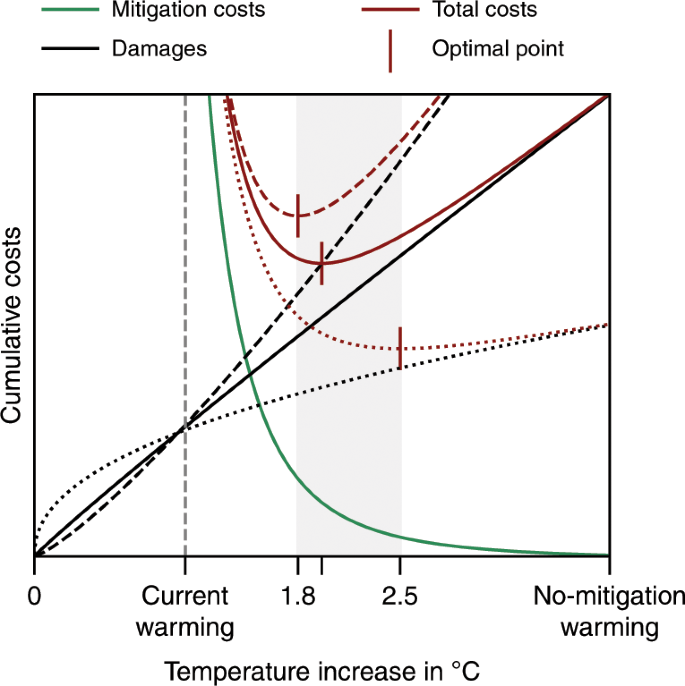
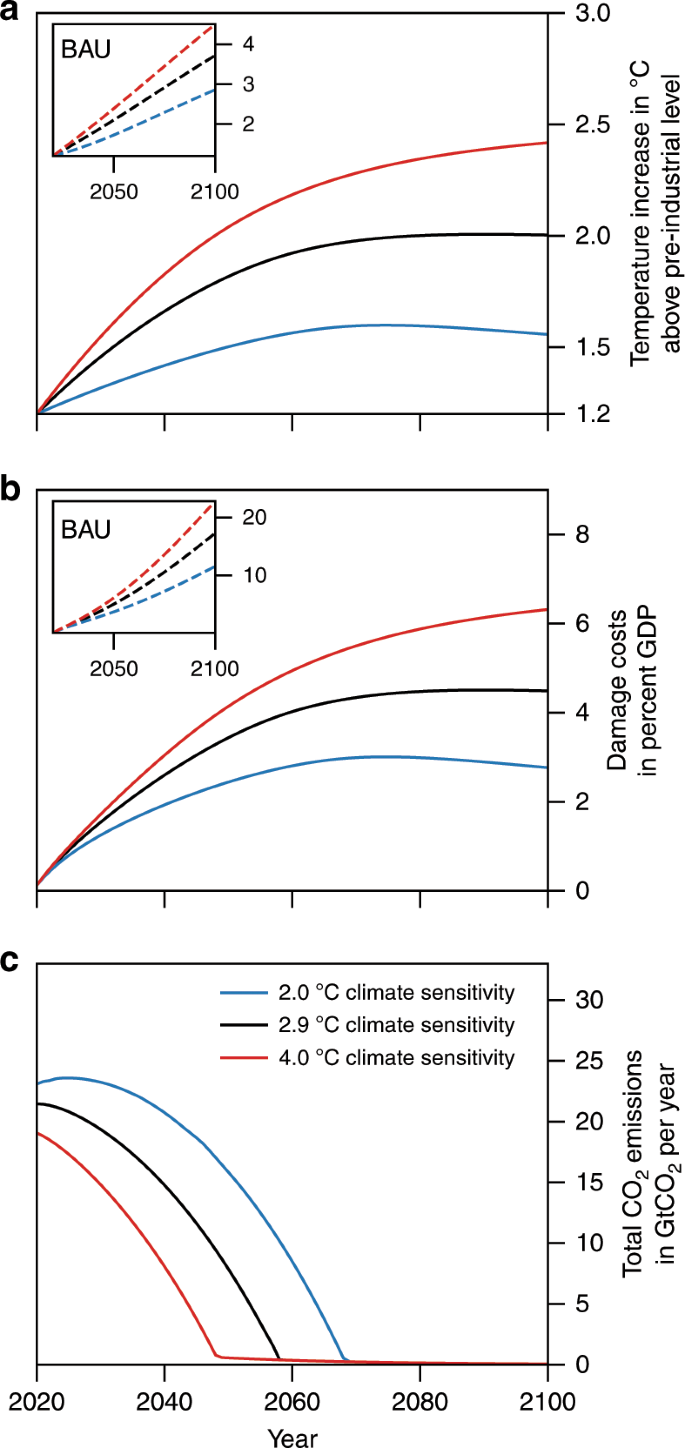
[The authors] find that the 2 °C target represents the cost-benefit optimal temperature for the base calibration (Fig. 2a). This calibration involves the best estimate8 of the temperature–economic growth relation in the past and the original ECS [equilibrium climate sensitivity] value in DICE-2013 of 2.9 °C, which is at the centre of estimates for several decades. Higher ECS values shift the level of target warming for which the mitigation-cost curve diverges to infinity to higher values (Fig. 1), i.e. they incur substantially higher mitigation costs. For ECS of 4 °C, for instance, the 2 °C target becomes too costly. Yet, with an optimal target warming of 2.4 °C the deviation from this target is not large. For smaller ECS values, e.g. of 2 °C, limiting warming further to well below 2 °C is economically optimal. Regardless of the exact ECS, the optimal mitigation efforts promise a significant damage reduction compared to the BAU [business-as-usual] scenario (~14% for ECS of 4 °C, ~10% for ECS of 2.9 °C, and ~8% for ECS of 2 °C). These efforts are, as also claimed by the Paris Agreement, ambitious (Article 3)1 and involve very stringent measures from the outset (Fig. 2c).
Fig. 1: Illustration of universality of the cost-benefit climate analysis.
figure1

Cumulative mitigation costs (green curve) and climate damages (black curve) as a function of Earthʼs warming level give the total climate costs (red curve). Mitigation costs diverge for present-day warming and converge to zero for unmitigated warming. The damages are zero for zero warming and increase with temperature. The characteristic steepness of the mitigation curve implies that beyond a certain damage level the economically optimal temperature (which minimizes the total costs) becomes insensitive to a further increase in damages. For example, increasing (black dashed) or decreasing (black dotted) the damage level by half of the initial damage level does not change the economically optimal warming level significantly (grey area).
Fig. 2: Temperature increase, damage costs, and carbon emissions under cost-benefit optimal policy for three different climate sensitivities.
figure2
The black curves are associated with the original calibration of the climate sensitivity of 2.9°C; the blue curves with a 2°C climate sensitivity and the red curve with a 4°C climate sensitivity. The inset figures allow comparing the economically optimal temperature development and damage costs with their corresponding values in the BAU scenario.
by Nicole Glanemann, Sven N. Willner & Anders Levermann 
Nature Communications https://www.nature.com/ncomms/
Volume 11, Article Number: 110; (2020); Open Access; Published: 27 January 2020

Saturday, September 29, 2018

Country-level social cost of carbon

Abstract:
The social cost of carbon (SCC) is a commonly employed metric of the expected economic damages from carbon dioxide (CO2) emissions. Although useful in an optimal policy context, a world-level approach obscures the heterogeneous geography of climate damage and vast differences in country-level contributions to the global SCC, as well as climate and socio-economic uncertainties, which are larger at the regional level. Here we estimate country-level contributions to the SCC using recent climate model projections, empirical climate-driven economic damage estimations and socio-economic projections. Central specifications show high global SCC values (median, US$417 per tonne of CO2 (tCO2); 66% confidence intervals, US$177–805 per tCO2) and a country-level SCC that is unequally distributed. However, the relative ranking of countries is robust to different specifications: countries that incur large fractions of the global cost consistently include India, China, Saudi Arabia and the United States.

by Katharine Ricke, Laurent Drouet, Ken Caldeira & Massimo Tavoni 
Nature Climate Change
Volume 8, Published: 24 September 2018; pages 895–900

which appeared in Inside Climate News Stacy Morford notes that the future economic costs within the U.S. borders are the second-highest in the world, behind only India."
The results suggest that the U.S. has been underestimating how much it benefits from reducing its greenhouse gas emissions and that the country has far more to gain from international climate agreements than the Trump administration is willing to admit.
"Our analysis demonstrates that the argument that the primary beneficiaries of reductions in carbon dioxide emissions would be other countries is a total myth," said lead author Kate Ricke, an assistant professor at the University of San Diego's School of Global Policy and Strategy and Scripps Institution of Oceanography.
Some smaller countries are expected to lose significantly larger portions of their economies to climate change. But the authors found, after modeling hundreds of scenarios, that the U.S. consistently faces among the costliest damages, as measured by what economists call the social cost of carbon....
The U.S.'s share of the global damage, about 12 percent according to the study, is slightly less than its share of the global emissions. But India's share of the damage is four times higher than its contribution.
Countries' share of global social cost of carbon vs. share of global emissions
The case of Russia shows how some of the major emitters could even gain from rising temperatures, as a warming Siberia would benefit Russia economically in the short term, according to the findings, (though the estimates don't account for longer-term impacts the country will face, such as damage to Arctic ecosystems and the rising ocean). Northern Europe and Canada also could have low costs or even short-term net benefits from CO2 emissions, according to the estimates.
If these countries only considered the current economic impact within their borders, they would appear to have little incentive to cut their emissions.
...
The U.S. government uses a social cost of carbon in its cost-benefit analyses when it designs new environmental regulations or rewrites old ones, but its numbers are much lower than those in the study.
The Obama administration set its median social cost of carbon at about $42 per metric ton for 2020. It based that on calculations of the global harm being created by each ton of U.S. emissions. When the Trump administration came in, it argued that the social cost of carbon should only address the impact on the U.S., and it wanted a higher discount rate. When the Trump administration issued its cost-benefit analysis for rolling back the Clean Power Plan, it cited numbers closer to $3 per ton.
Looking just at the impact within U.S. borders, the new study estimates the U.S. social cost of carbon emissions is nearly $48 per ton.
That wouldn't support the Trump administration's plans for weakening the Clean Power Plan and energy efficiency standards.

Wednesday, September 27, 2017

Assessing the costs and benefits of US renewable portfolio standards - IOPscience

Abstract
Renewable portfolio standards (RPS) exist in 29 US states and the District of Columbia. This article summarizes the first national-level, integrated assessment of the future costs and benefits of existing RPS policies; the same metrics are evaluated under a second scenario in which widespread expansion of these policies is assumed to occur. Depending on assumptions about renewable energy technology advancement and natural gas prices, existing RPS policies increase electric system costs by as much as $31 billion, on a present-value basis over 2015−2050. The expanded renewable deployment scenario yields incremental costs that range from $23 billion to $194 billion, depending on the assumptions employed. The monetized value of improved air quality and reduced climate damages exceed these costs. Using central assumptions, existing RPS policies yield $97 billion in air-pollution health benefits and $161 billion in climate damage reductions. Under the expanded RPS case, health benefits total $558 billion and climate benefits equal $599 billion. These scenarios also yield benefits in the form of reduced water use. RPS programs are not likely to represent the most cost effective path towards achieving air quality and climate benefits. Nonetheless, the findings suggest that US RPS programs are, on a national basis, cost effective when considering externalities.

Figure 3.
Range of benefit and cost estimates for the Existing RPS Policies and High RE scenarios, relative to the Reference scenario. Note that negative values in the figure indicate increased costs and that the central values for the air quality and the climate damage benefits are highlighted with a bolded marker.


by Ryan Wiser 1 and 3, Trieu Mai 2, Dev Millstein 1, Galen Barbose 1, Lori Bird 2, Jenny Heeter 2, David Keyser 2, Venkat Krishnan 2 and Jordan Macknick 2
1. Lawrence Berkeley National Laboratory. 1 Cyclotron Road, Berkeley, CA 94720, United States of America
2. National Renewable Energy Laboratory. 15013 Denver West Parkway, Golden, CO 80401, United States of America
3. Author to whom any correspondence should be addressed RHWiser@lbl.gov
Environmental Research Letters http://iopscience.iop.org/journal/1748-9326 via
IOPscience http://iopscience.iop.org, Volume 12, Number 9 Published 26 September 2017

Monday, August 7, 2017

A global framework for future costs and benefits of river-flood protection in urban areas : Nature Climate Change

Floods cause billions of dollars of damage each year, and flood risks are expected to increase due to socio-economic development, subsidence, and climate change. Implementing additional flood risk management measures can limit losses, protecting people and livelihoods. Whilst several models have been developed to assess global-scale river-flood risk, methods for evaluating flood risk management investments globally are lacking. Here, we present a framework for assessing costs and benefits of structural flood protection measures in urban areas around the world. We demonstrate its use under different assumptions of current and future climate change and socio-economic development. Under these assumptions, investments in dykes may be economically attractive for reducing risk in large parts of the world, but not everywhere. In some regions, economically efficient investments could reduce future flood risk below today’s levels, in spite of climate change and economic growth. We also demonstrate the sensitivity of the results to different assumptions and parameters. The framework can be used to identify regions where river-flood protection investments should be prioritized, or where other risk-reducing strategies should be emphasized.
...
In this study, we used Representative Concentration Pathways (RCPs) and Shared Socioeconomic pathways (SSPs)2 to represent future climate and changes in future socioeconomic conditions, respectively. In total, there are 4 RCPs and 5 SSPs, leading to a matrix of 20 combinations of projections.
...
For the ‘optimise’ objective, there is a large difference between the RCP/SSP combinations in both the benefits and the costs. The costs at the global scale range from USD 22 billion per year (RCP2.6/SSP3) and 78 billion USD per year (RCP8.5/SSP5). Averaged across all SSPs, the results show that the costs at the global scale increase as the CO2-equivalent concentration increases (RCP2.6 = USD 40 billion per year; RCP4.5 = USD 45 billion per year; RCP6.0 = USD 47 billion per year; RCP8.5 = USD 55 billion per year). This means that globally, higher greenhouse gas concentrations will lead to higher adaptation costs as a result of a generally larger increases in flood hazard (note that there are also areas where higher greenhouse gas emissions lead to reduction in flood risk). For all combinations of RCP/SSP, on average, the benefits far outweigh the costs, leading to B:C ratios ranging from 3.6 (RCP2.6/SSP3 and RCP4.5/SSP3) to 10.2 (RCP8.5/SSP5). The B:C ratios are also larger for the RCPs with higher CO2 concentrations, since the larger increase in hazard under those RCPs means that flood damage is higher, and therefore the potential avoided damage is also higher. Averaged across all RCPs, the costs at the global scale follow the projected increases in GDP to 2080 between the different SSPs (i.e. highest costs in SSP5 and lowest costs in SSP3, which are the SSPs with the highest and lowest global GDP growth respectively).

Under the ‘constant absolute risk’ objective, B:C ratios exceed 1 for all RCPs combined with SSPs. However, for SSP, which represents a more fragmented world, the B:C ratios are less than, because under this scenario, economic prospects are poor and thus the benefits of adaptation low. Under the ‘constant absolute risk’ objective’, B:C ratios exceed 1 for all combinations of RCPs and SSPs.

Percentage reduction in current expected annual damage for simulations carried out with assumed current protection standards compared to no flood protection
Percentage reduction in current expected annual damage for simulations carried out with assumed current protection standards compared to no flood protection.

B:C ratio at sub-national level, and percentage of models for which B:C ratio exceeds 1, for the EAD-constant and EAD/GDP-constant adaptation objections
B:C ratio at sub-national level, and percentage of models for which B:C ratio exceeds 1, for the EAD-constant and EAD/GDP-constant adaptation objections.

Protection standards at sub-national level in 2080 and associated B:C ratios
Protection standards at sub-national level in 2080 and associated B:C ratios.
http://www.nature.com/nclimate/journal/vaop/ncurrent/full/nclimate3350.html
by Philip J. Ward, Brenden Jongman, Jeroen C. J. H. Aerts, Paul D. Bates, Wouter J. W. Botzen, Andres Diaz Loaiza, Stephane Hallegatte, Jarl M. Kind, Jaap Kwadijk, Paolo Scussolini & Hessel C. Winsemius
Nature Climate Change http://www.nature.com
Published online 31 July 2017